The owner of the restaurant looks at the sales before focusing on the bottom line before closing the report.
Do you recognize yourself?
If just those two numbers are examined the report’s true worth is lost.
A reliable bookkeeping system for restaurants should not increase the dependence of restaurant owners on accountants. It should give them confidence in their own numbers. There is no need to be familiar with each accounting rule, or have to spend hours completing invoices. You do need to understand why profit moved, what happened to costs for food and labor and which issues require attention next week.
Bookkeeping Chef’s mission is to automate bookkeeping chores that do not require the attention of restaurant owners, and provide users with better financial information that they can make use of.
Do Not Stop at the Month-End Numbers. Start with the Weekly Numbers
While restaurants don’t operate within a calendar month they are still required to maintain an P&L. Managers schedule labor this week. Chefs order food right now. Vendors change prices now.
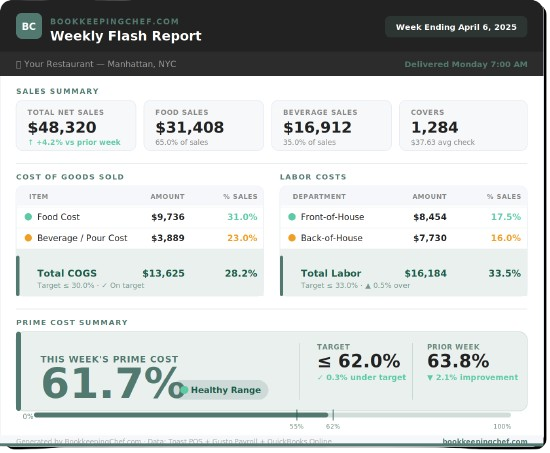
This is the reason Bookkeeping Chef provides weekly prime-cost flash reports alongside monthly financial statements.
The primary cost is comprised of the cost of labor and the purchase of goods as well as the cost of labor. These are two areas in which an establishment can achieve rapid growth. The information provided by the Bookkeeping Chef indicates that prime costs generally account for 60 percent of sales at restaurants.
Let’s say sales have not changed at all however the price of prime is increasing. This percentage by itself will not offer the answer. It gives the person in charge a reason to conduct an investigation.
Was there an increase in the hours worked? Did overtime happen? Did food costs change? The invoice from the vendor seemed oddly big? Did the sales mix change?
This is much better than finding the same problem two weeks later.
Let Automation Handle the Repetitive Work
Self-bookkeeping doesn’t mean manually moving POS numbers into spreadsheets.
Automating restaurant bookkeeping can help with the frequent movement of financial information. The service connects systems including POS, QuickBooks, payroll vendors, vendor platforms, inventory and recipe management, as well Payment and AP tools.
Automating just for the sake of automation is not the objective.
It’s to make it easier for manual data entry, and keep financial records up-to-date so that the owner can spend time looking over data instead of creating it.
This leads to a different style of bookkeeping for restaurants. technology is able to handle more mechanics while the owner remains involved in the financial aspects.
Ask more questions regarding P&L
Stop thinking of your P&L as if it were an accounting test.
Begin by studying the sales. Then, you can look at the costs of production. Compare the performance of food and beverages. Examine labor. Reduce operating expenses and see what remains.
More importantly, compare periods.
If sales increase but profits don’t, there is an alteration between them. What changed within the organization when food costs grew. Examine sales and staffing levels to determine if the labour percent has changed. Investigate if a number seems odd, rather than thinking that the restaurant went through poor times.
Bookkeeping Chef provides monthly P&Ls which are finalized in just five business days. This provides owners the opportunity to evaluate recent results rather than receive financial statements long after the operating period has ended.
For owners searching bookkeeping restaurant solutions, speed is useful but understanding is the bigger objective.
It’s not necessary to take on everything by yourself in case you do it yourself
You can find a comfortable compromise between hiring someone else to manage your financial needs and having your own personal accountant.
You are able to be a business owner without performing the entire accounting process by hand.
It could involve connecting to automated systems to ensure information flows by reviewing a weekly prime-cost report, or studying the monthly P&L, and asking questions in the event of an unexpected change.
Bookkeeping services for restaurants that are specialized in catering can assist restaurant owners comprehend the significance of reports by arranging the books and keeping them in order.
The result isn’t a owner who can do every bookkeeping function.
It’s an owner who can sit down with a P&L and have an intelligent discussion about the company.
The goal is Financial Independence Not More Reports
Restaurants already generate huge amounts of data. Another dashboard isn’t automatically useful.
Real value occurs the moment an operator opens the P&L report, be aware that there has been a change and then look at the prime-cost reports.
Bookkeeping Chef’s strategy integrates restaurant accounting automation with daily reports, monthly P&Ls and the provision of financial support for specific restaurants to make this process possible.
Automate repetitive tasks. Check your top costs each week. Study the language of your P&L.
You don’t have to be a professional accountant.
Owners who are familiar with the financial aspects of their own restaurants will be able make better choices.
